
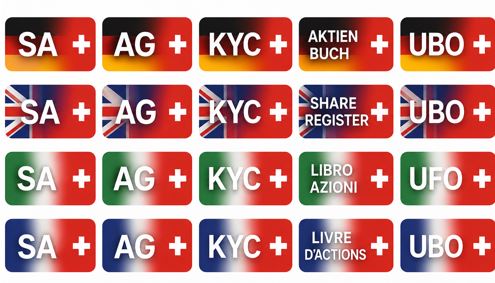
Swiss AG (Ltd.): Share Register, UBO, KYC and the Role of the Board of Directors – Simply Explained
In a Swiss stock corporation (AG), several concepts and registers must be distinguished from one another. This overview explains the main differences in simplified form.
1. Share Register (Aktienbuch)
The share register is an internal register of the AG. For registered shares, it records the shareholders or registered holders and the relevant information relating to their shares. In simplified terms, it answers the question: Who is registered as the holder of the registered shares?
The share register is distinct from the Commercial Register. It is maintained by the company and is generally not a public register.
2. UBO – Ultimate Beneficial Owner
UBO means “Ultimate Beneficial Owner”. It refers to the natural person who ultimately owns or controls a company.
Example: Mr X owns Holding GmbH, and Holding GmbH holds the shares of Consulting AG. Holding GmbH may appear in the share register of Consulting AG as the shareholder, while Mr X may – depending on the actual ownership and control structure – be the UBO.
3. KYC – Know Your Customer
KYC means “Know Your Customer”. It is the process used to identify and verify a customer. Depending on the activity and applicable requirements, this may include identity documents, address, Commercial Register extract, signing authorities, ownership structure and information concerning the UBO.
In short: KYC is the verification process; the UBO is a person or piece of information that may be relevant within that process.