EasyGov.swiss – registre de transparence / Transparency Register
New Transparency Register Law from October 2026

New Swiss Transparency Register from 1 October 2026: what companies need to know now

On 1 October 2026, the new Federal Act on the Transparency of Legal Entities and the Identification of Beneficial Owners (TJPG) enters into force. At the same time, the new Swiss Transparency Register begins operating.

With this change, the Confederation is creating a central register in which the beneficial owners of certain companies and legal entities are recorded. The aim is to increase transparency and to strengthen the fight against money laundering and terrorist financing.

Which companies are affected?

The new reporting obligation applies in particular to Swiss corporations such as companies limited by shares (AG / SA) and limited liability companies (GmbH / Sàrl), as well as cooperatives.

However, exceptions exist depending on the legal form and the situation. For example, sole proprietorships, associations, foundations and listed companies are generally not required to register in the Transparency Register.

Companies should therefore check in good time whether they fall under the new legal provisions.

What is a beneficial owner?

Beneficial owners are, in principle, the natural persons who ultimately control a company – for example through their direct or indirect shareholding, their voting rights or in some other way.

The companies concerned must identify, verify and keep up to date the required information on these persons.

How is the report made?

Reports to the Swiss Transparency Register are generally submitted electronically via the EasyGov.swiss platform.

The Transparency Register starts regular operation on 1 October 2026. The statutory transitional periods for the registration of the entities concerned also begin on that date.

What should you do now?

To be prepared for the new requirements, we recommend in particular the following steps:

  • Check or create your EasyGov access: make sure you have working access to EasyGov.swiss.
  • Review ownership and control structures: clarify early on which natural persons qualify as the beneficial owners of your company.
  • Prepare the required information: gather the information needed for the report and check that it is accurate.
  • Clarify your company’s reporting obligation: early clarification is advisable, especially for complex shareholding, holding or group structures.

We are happy to help

Identifying the beneficial owners can be demanding, especially with multi-level shareholdings, holding structures or indirect participations.

We will gladly support you in assessing your situation, identifying the persons to be reported and answering your questions about the new legal requirements.

Do you have questions about the new Transparency Register, or would you like to know whether your company is affected? Contact us – we will be happy to advise you.
Setup guides

Registre des actions et structure d'une SA suisse domiciliée à Zoug
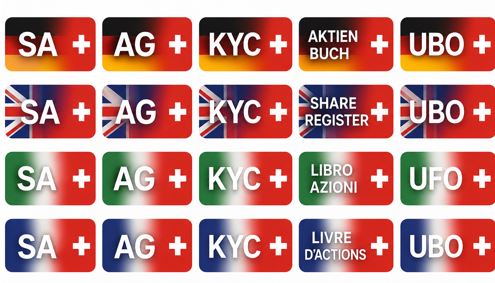
Swiss AG (Ltd.): Share Register, UBO, KYC and the Role of the Board of Directors – Simply Explained

In a Swiss stock corporation (AG), several concepts and registers must be distinguished from one another. This overview explains the main differences in simplified form.

1. Share Register (Aktienbuch)

The share register is an internal register of the AG. For registered shares, it records the shareholders or registered holders and the relevant information relating to their shares. In simplified terms, it answers the question: Who is registered as the holder of the registered shares?

The share register is distinct from the Commercial Register. It is maintained by the company and is generally not a public register.

2. UBO – Ultimate Beneficial Owner

UBO means “Ultimate Beneficial Owner”. It refers to the natural person who ultimately owns or controls a company.

Example: Mr X owns Holding GmbH, and Holding GmbH holds the shares of Consulting AG. Holding GmbH may appear in the share register of Consulting AG as the shareholder, while Mr X may – depending on the actual ownership and control structure – be the UBO.

3. KYC – Know Your Customer

KYC means “Know Your Customer”. It is the process used to identify and verify a customer. Depending on the activity and applicable requirements, this may include identity documents, address, Commercial Register extract, signing authorities, ownership structure and information concerning the UBO.

In short: KYC is the verification process; the UBO is a person or piece of information that may be relevant within that process.

Full Article.

Changement du décompte TVA suisse dès mai 2026
VAT Change from May 2026

🔔 VAT Change from May 2026

🔗 Link for the change:
https://www.mwstabrechnen.estv.admin.ch/

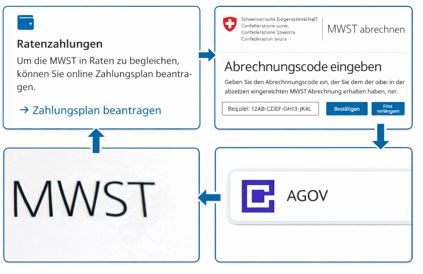
From May 2026, it is not the Swiss VAT rate that is changing, but the way to access the online VAT return. The FTA will discontinue the “VAT Return easy” service. After that, VAT returns will only be submitted via “VAT Return pro” in myESTV / myAFC.

In addition, registration and login via AGOV will become mandatory from 31 October 2026. CH-Login will be discontinued at the end of 2027.

✅ In practical terms:
It is better to prepare early:
set up your AGOV access once, activate myESTV, and use VAT Return pro for future filing periods.

🔐 AGOV login

There are two main options:

  • 📱 AGOV access app on your smartphone
  • 🔑 FIDO2 security key (USB)
    (from around CHF 19 at Galaxus.ch)

Through your online account, you can also manage your VAT more effectively in case of difficulties and avoid 📩 reminders or ⚠️ debt enforcement proceedings.

🕒 a) Request a deadline extension online
If you need more time to submit your VAT return, you should request an extension online as quickly as possible.
A 📬 code sent by post can then be entered in your account.

💳 b) Request an instalment payment plan online
If needed, you can also apply online for payment by instalments / a payment plan.

💡 Important:
If you act early instead of waiting and reacting too late, you can avoid loss of time, unnecessary effort, and extra costs.

Numéro de téléphone fixe local 041 pour une entreprise domiciliée à Zoug
Local landline number in Zug

📞 Local landline number in Zug

A professional image for your business

Having a local landline number with the 041 area code is a real advantage for a business in Zug.
It strengthens your professional image, inspires confidence in your clients, and gives your company a clear and professional local presence.

With a business landline, you remain easy to reach and flexible, according to your needs.

✅ Basic solutions

📞 Local number in Zug (041 xxx xx xx) — CHF 10.– / month
⚙️ Setup — CHF 45.– (one-time fee)
📝 Manual message taking — CHF 3.50 / message
📲 Permanent call forwarding to your mobile — according to the desired configuration
🔄 Semi-permanent call forwarding — according to the desired configuration
☎️ Manual call transfer — according to the desired configuration

📋 Conditions

Various configurations are possible according to your wishes.
The solution can be adapted to your way of working and to the organization of your business.

📩 Contact us